Entendendo o progresso da ciência

segunda-feira, julho 09, 2018

McCoy, C.D. (2018) Understanding the Progress of Science. [Preprint]


Abstract

This paper develops a problem-solving account of scientific progress that takes understanding as the principal epistemic aim of science. It examines a recent paper of Bird's on scientific progress, argues for the primacy of understanding over knowledge in this context, illustrates the account using a Kuhnian picture of science, and defends it against knowledge reductionism.

FREE PDF GRATIS: PhilSci

Rastros ediacaranos tardios produzidos por animais bilatérios com apêndices pareados


Late Ediacaran trackways produced by bilaterian animals with paired appendages

Zhe Chen1,2,*, Xiang Chen1,3, Chuanming Zhou2,4, Xunlai Yuan1,2,3 and Shuhai Xiao5,*

1State Key Laboratory of Palaeobiology and Stratigraphy, Nanjing Institute of Geology and Palaeontology, Chinese Academy of Sciences, Nanjing 210008, China.

2Center for Excellence in Life and Paleoenvironment, Chinese Academy of Sciences, Nanjing 210008, China.

3University of Chinese Academy of Sciences, Beijing 100049, China.

4CAS Key Laboratory of Economic Stratigraphy and Palaeogeography, Nanjing Institute of Geology and Palaeontology, Chinese Academy of Sciences, Nanjing 210008, China.

5Department of Geosciences, Virginia Polytechnic Institute and State University, Blacksburg, VA 24061, USA.

↵*Corresponding author. Email: xiao@vt.edu (S.X.); zhechen@nigpas.ac.cn (Z.C.)

Science Advances 06 Jun 2018:

Vol. 4, no. 6, eaao6691


Trackways and burrows excavated in situ from the Shibantan Member.

Abstract

Ediacaran trace fossils provide key paleontological evidence for the evolution of early animals and their behaviors. Thus far, however, this fossil record has been limited to simple surface trails and relatively shallow burrows. We report possible trackways, preserved in association with burrows, from the terminal Ediacaran Shibantan Member (ca. 551 to ca. 541 million years ago) in the Yangtze Gorges area of South China. These trace fossils represent the earliest known trackways. They consist of two rows of imprints arranged in poorly organized series or repeated groups. These trackways may have been produced by bilaterian animals with paired appendages, although the phylum-level phylogenetic affinity of the trace makers remains unknown. It is possible that the trackways and associated burrows were produced by the same trace maker, indicating a complex behavior involving both walking and burrowing. Together, these trackways and burrows mark the arrival of a new era characterized by an increasing geobiological footprint of bilaterian animals.

FREE PDF GRATIS: Science Advances Sup. Info.

Nova dinâmica inesperada para grandes moléculas de DNA em suspensão líquida

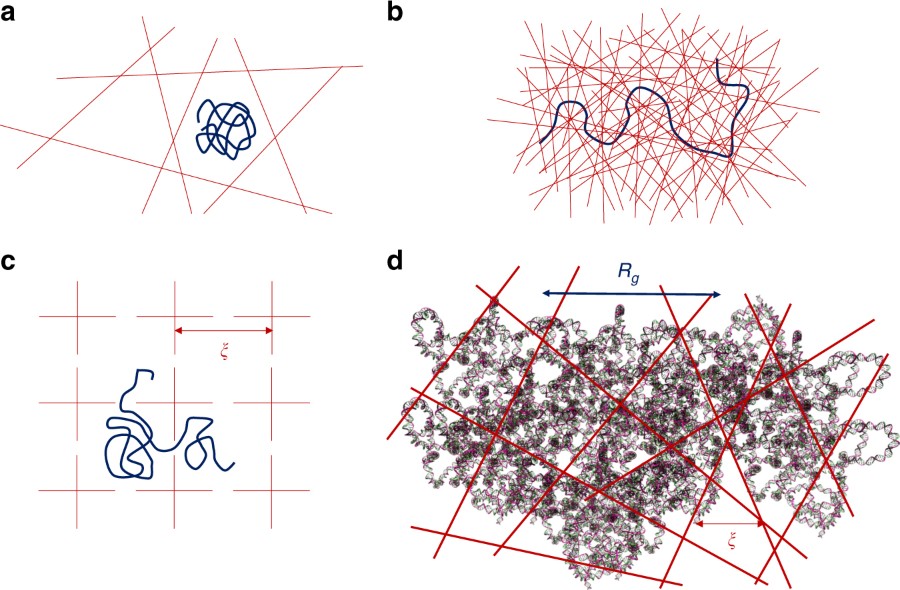
Topologically frustrated dynamics of crowded charged macromolecules in charged hydrogels

Di Jia & Murugappan Muthukumar 

Nature Communications volume 9, Article number: 2248 (2018) 

Fig. 1

Abstract

Movement of charged macromolecules in crowded aqueous environments is a ubiquitous phenomenon vital to the various living processes and formulations of materials for health care. While study of diffusion of tracer amounts of probe macromolecules trapped inside concentrated solutions, gels, or random media has led to an enhanced understanding of this complex process, the collective dynamics of charged macromolecules embedded inside congested charge-bearing matrices still remains to be fully explored. Here we report a frustrated dynamics of DNA and synthetic polyelectrolytes inside a charged host hydrogel where the guest molecules do not diffuse. Instead, they exhibit a family of relaxation processes arising from a combination of conformational entropy and local chain dynamics, which are frustrated by the confinement from the gel. We also have developed a model explaining this new universality class of non-diffusive topologically frustrated dynamics of charged macromolecules.

Acknowledgements

We thank the National Science Foundation (DMR-1504265), AFOSR Grant FA9550-17-1-0160, and the National Institutes of Health (Grant No. R01HG002776-11) for financial support.

Author information

Affiliations

Department of Polymer Science and Engineering, University of Massachusetts, Amherst, MA, 01003, USA

Di Jia & Murugappan Muthukumar

Contributions

M.M. conceived the project. D.J. designed the experiments, synthesized the gel, and performed all experiments. M.M. developed the theory. Both authors discussed and contributed to the interpretation of the data. The whole project was supervised by M.M.

Competing interests

The authors declare no competing interests.

Corresponding author

Correspondence to Murugappan Muthukumar.

O espectro de muitas espécies

domingo, julho 08, 2018

2018 Jul Syst Biol - Leaché et al - The Spectre of Too Many Species

Adam D Leaché Tianqi Zhu Bruce Rannala Ziheng Yang

Systematic Biology, syy051, https://doi.org/10.1093/sysbio/syy051

Published: 05 July 2018 Article history

Received: 07 November 2017 Revision Received: 22 June 2018

Accepted: 29 June 2018


Abstract

Recent simulation studies examining the performance of Bayesian species delimitation as implemented in the BPP program have suggested that BPP may detect population splits but not species divergences and that it tends to over-split when data of many loci are analyzed. Here we confirm these results and provide the mathematical justifications. We point out that the distinction between population and species splits made in the protracted speciation model has no influence on the generation of gene trees and sequence data, which explains why no method can use such data to distinguish between population splits and speciation. We suggest that the protracted speciation model is unrealistic as its mechanism for assigning species status assumes instantaneous speciation, contradicting prevailing taxonomic practice. We confirm the suggestion, based on simulation, that in the case of speciation with gene flow, Bayesian model selection as implemented in BPP tends to detect population splits when the amount of data (the number of loci) increases. We discuss the use of a recently proposed empirical genealogical divergence index (gdi) for species delimitation and illustrate that parameter estimates produced by a full likelihood analysis as implemented in BPP provide much more reliable inference under the gdi than the approximate method PHRAPL. We distinguish between Bayesian model selection and parameter estimation, and suggest that the model selection approach is useful for identifying sympatric cryptic species while the parameter estimation approach may be used to implement empirical criteria for determining species status among allopatric populations.

Species delimitation, BPP, multispecies coalescent, taxonomy

Issue Section: POINT OF VIEW

© The Author(s) 2018. Published by Oxford University Press, on behalf of the Society of Systematic Biologists.

This is an Open Access article distributed under the terms of the Creative Commons Attribution Non-Commercial License (http://creativecommons.org/licenses/by-nc/4.0/), which permits non-commercial re-use, distribution, and reproduction in any medium, provided the original work is properly cited. For commercial re-use, please contact journals.permissions@oup.com

FREE PDF GRATIS: Systematic Biology

As discrepâncias de dados podem afetar nosso entendimento do universo

Cosmological discordances. II. Hubble constant, Planck and large-scale-structure data sets

Weikang Lin and Mustapha Ishak

Phys. Rev. D 96, 083532 – Published 30 October 2017


A visual history of the expanding Universe includes the hot, dense state known as the Big Bang and the growth and formation of structure subsequently. But quantitatively knowing what the expansion rate is (and was) in the present (and past) is vital to understanding our cosmic history and future. Source/Fonte

ABSTRACT

We examine systematically the (in)consistency between cosmological constraints as obtained from various current data sets of the expansion history, large-scale-structure (LSS), and cosmic microwave background (CMB) temperature and polarization from Planck. We run (dis)concordance tests within each set and across the three sets using a recently introduced index of inconsistency (IOI) capable of dissecting inconsistencies between two or more data sets. First, we compare the constraints on 
H0
 from five different methods and find that the IOI drops from 2.85 to 0.88 (on Jeffreys’s scales) when the local 
H0
 measurements are removed. This seems to indicate that the local measurement is an outlier compared to the others, thus favoring a systematics-based explanation. We find a moderate inconsistency (
IOI=2.61
) between Planck temperature and polarization data sets. We find that current LSS data sets including the WiggleZ power spectrum, SDSS redshift space distortion, CFHTLenS weak lensing, CMB lensing, and cluster count from SZ effect, are consistent one with another and also when all combined. However, we find a persistent moderate inconsistency between Planck and individual or combined LSS probes. For Planck 
TT+lowTEB
 versus individual LSS probes, the IOI spans the range 2.92–3.72 and increases to 3.44–4.20 when the polarization data is added in. The joint LSS versus the combined Planck temperature and polarization has an IOI of 2.83 in the most conservative case. But if Planck low-
ℓ
 temperature and polarization is also added to the joint LSS to constrain 
τ
 and break degeneracies, the inconsistency between Planck and joint LSS data increases to the high end of the moderate range with 
IOI=4.81
. Whether due to systematic effects in the data or to the underlying model, these inconsistencies need to be resolved. Finally, we perform forecast calculations using the Large Sky Synoptic Survey (LSST) and find that the discordance between Planck and future LSS data, if it persists as present, can rise up to a high IOI of 17, thus falling in the strong range of inconsistency.


Received 1 September 2017
© 2017 American Physical Society
Physics Subject Headings (PhySH)
Research Areas Cosmological parameters Cosmology Gravitation, Cosmology & Astrophysics
Subscription or payment needed/Requer assinatura ou pagamento:

Physical Review D 

Francisco Ayala, famoso geneticista evolucionista, perde cargo: assédio sexual contra várias mulheres

terça-feira, julho 03, 2018

Acclaimed UC Irvine geneticist who gave millions to the campus resigns due to sexual harassment

By Teresa Watanabe


Acclaimed UC Irvine geneticist Francisco J. Ayala has resigned after a university investigation found he sexually harassed four faculty members and graduate students, the university has announced.

Ayala, a former Dominican priest who won the prestigious Templeton Prize for championing both science and faith, resigned effective July 1 and will abstain from future university activities, UCI officials said.

“I deeply regret that what I have always thought of as the good manners of a European gentleman — to greet women colleagues warmly, with a kiss to both cheeks, to compliment them on their beauty — made colleagues I respect uncomfortable,” Ayala, who grew up in Madrid, said Friday in a statement. “It was never my intent to do so.”

He said he had “too much respect” for the women, his family and UC Irvine to continue defending himself with hearings, appeals or lawsuits and would continue his research “with renewed vigor” elsewhere.

In 2011, Ayala donated $10 million to the School of Biological Sciences, which then bore his name. It was the largest gift from a faculty member at the time.

The university said Ayala’s name has been removed from that school, and also is being removed from its central science library, graduate fellowships, scholar programs and endowed chairs. The biology school will now be known as the UCI School of Biological Sciences.

“I thank and commend our colleagues who reported this misconduct,” Chancellor Howard Gillman said in a statement Thursday. “Coming forward with this information was extremely courageous. Professor Ayala’s behavior defied our core beliefs and was inconsistent with our policies, guidelines and required training.”

Micha Liberty, an attorney who represents three of the women, said UCI ignored years of complaints from professors and graduate students that Ayala touched them and made sexual and sexist comments. She said one of the professors she’s representing reported Ayala’s conduct three years ago, but university officials failed to investigate or sanction him.

“They just told him, ‘Stay away from her,’ ” Liberty said. “Dr. Ayala has had a long and successful career and was clearly an asset to the UCI campus … and that in turn motivated UCI to look the other way when it came to complaints of sexual harassment.”

The university started the investigation last November. The women, who asked to be identified, are Kathleen Treseder, professor and chair of ecology and evolutionary biology; Jessica Pratt, an assistant teaching professor; Benedicte Shipley, an assistant dean; and Michelle Herrera, a graduate student.

After interviews with the women and more than 60 witnesses, the university substantiated the complaints last month.

UCI advisors are reaching out to the school’s faculty, students, staff and administration to provide counseling services and harassment-related education, officials said.

Liberty said her clients are dissatisfied that UCI has not acknowledged its failure to act on previous complaints and protect women from Ayala. She said there are many more victims but most are scared to come forward because his stature in the field gives him the power to make or break careers.

“In the face of overwhelming evidence, UCI came up with an anemic response to a systemic failure,” she said.
...
Read more here: Los Angeles Times

Darwin, o biofísico Ken Dill 'falou e disse': as máquinas de proteínas são MÁQUINAS, não são METÁFORAS!!!

quinta-feira, junho 28, 2018

Alô ETs, disquem 0800-NASA

terça-feira, junho 26, 2018

Exoplanet Biosignatures: A Review of Remotely Detectable Signs of Life

Schwieterman Edward W. , Kiang Nancy Y. , Parenteau Mary N. , Harman Chester E. , DasSarma Shiladitya , Fisher Theresa M. , Arney Giada N. , Hartnett Hilairy E. , Reinhard Christopher T. , Olson Stephanie L. , Meadows Victoria S. , Cockell Charles S. , Walker Sara I. , Grenfell John Lee , … Show all Authors 

Published Online:1 Jun 2018 https://doi.org/10.1089/ast.2017.1729

Image result for ET
Source/Fonte: MovieWeb

Abstract

In the coming years and decades, advanced space- and ground-based observatories will allow an unprecedented opportunity to probe the atmospheres and surfaces of potentially habitable exoplanets for signatures of life. Life on Earth, through its gaseous products and reflectance and scattering properties, has left its fingerprint on the spectrum of our planet. Aided by the universality of the laws of physics and chemistry, we turn to Earth's biosphere, both in the present and through geologic time, for analog signatures that will aid in the search for life elsewhere. Considering the insights gained from modern and ancient Earth, and the broader array of hypothetical exoplanet possibilities, we have compiled a comprehensive overview of our current understanding of potential exoplanet biosignatures, including gaseous, surface, and temporal biosignatures. We additionally survey biogenic spectral features that are well known in the specialist literature but have not yet been robustly vetted in the context of exoplanet biosignatures. We briefly review advances in assessing biosignature plausibility, including novel methods for determining chemical disequilibrium from remotely obtainable data and assessment tools for determining the minimum biomass required to maintain short-lived biogenic gases as atmospheric signatures. We focus particularly on advances made since the seminal review by Des Marais et al. The purpose of this work is not to propose new biosignature strategies, a goal left to companion articles in this series, but to review the current literature, draw meaningful connections between seemingly disparate areas, and clear the way for a path forward. 

Key Words: Exoplanets—Biosignatures—Habitability markers—Photosynthesis—Planetary surfaces—Atmospheres—Spectroscopy—Cryptic biospheres—False positives. Astrobiology 18, 663–708.

FREE PDF GRATIS: Astrobiology

A vida, o universo, e tudo - 42 questões fundamentais

segunda-feira, junho 25, 2018

Life, the Universe, and everything—42 fundamental questions

Roland E Allen 1 and Suzy Lidström 2,3

Published 15 November 2016 • © 2016 The Royal Swedish Academy of Sciences

Physica Scripta, Volume 92, Number 1 


Author affiliations

1 Department of Physics and Astronomy, Texas A&M University College Station, Texas 77843, USA

2 Department of Physics and Astronomy, Uppsala University SE-75120 Uppsala, Sweden

3 Physica Scripta, Royal Swedish Academy of Sciences SE-104 05 Stockholm, Sweden

Dates

Received 5 August 2016 Accepted 24 October 2016 

Published 15 November 2016

Check for updates using Crossmark

Peer review information

Method: Single-blind

Revisions: 1

Screened for originality? Yes

Citation

Roland E Allen and Suzy Lidström 2017 Phys. Scr. 92 012501


Image result for questions marks

Abstract

In The Hitchhiker's Guide to the Galaxy, by Douglas Adams, the Answer to the Ultimate Question of Life, the Universe, and Everything is found to be 42—but the meaning of this is left open to interpretation. We take it to mean that there are 42 fundamental questions which must be answered on the road to full enlightenment, and we attempt a first draft (or personal selection) of these ultimate questions, on topics ranging from the cosmological constant and origin of the Universe to the origin of life and consciousness.

+++++

Original content from this work may be used under the terms of the Creative Commons Attribution 3.0 licence. Any further distribution of this work must maintain attribution to the author(s) and the title of the work, journal citation and DOI.

FREE PDF GRATIS: Physica Scripta

Dan Graur, o DNA "Lixo" é CRUCIAL no desenvolvimento de embriões!!!

sexta-feira, junho 22, 2018

A LINE1-Nucleolin Partnership Regulates Early Development and ESC Identity

Michelle Percharde, Chih-Jen Lin, Yafei Yin, Juan Guan, Gabriel A. Peixoto, Aydan Bulut-Karslioglu 6, Steffen Biechele, Bo Huang, Xiaohua Shen, Miguel Ramalho-Santos 7, 8

6 Present address: Max Planck Institute for Molecular Genetics, Berlin, Germany

7 Present address: Lunenfeld-Tanenbaum Research Institute and Department of Molecular Genetics, University of Toronto, Toronto, ON M5T 3H7, Canada

8 Lead Contact

Publication stage: In Press Corrected Proof

PlumX Metrics

Learn more about article metrics


Article Info

Publication History

Published: June 21, 2018 Accepted: May 17, 2018

Received in revised form: March 20, 2018 Received: August 12, 2017

In these two two-cell mouse embryos, the surface of the embryos is outlined in orange, the DNA in the nucleus is indicated in blue and the activity of the LINE-1 gene is indicated via bright red spots.
Ramalho-Santos lab/UCSF - Source/Fonte


Highlights

• LINE1 RNA is abundant and nuclear in mouse ESCs and pre-implantation embryos

• LINE1 knockdown inhibits ESC self-renewal and induces transition to a 2C state

• LINE1 RNA recruits Nucleolin/Kap1 to repress Dux and activate rRNA synthesis

• In embryos, LINE1 inhibition causes persistence of the 2C program and impairs ZGA

Summary

Transposable elements represent nearly half of mammalian genomes and are generally described as parasites, or “junk DNA.” The LINE1 retrotransposon is the most abundant class and is thought to be deleterious for cells, yet it is paradoxically highly expressed during early development. Here, we report that LINE1 plays essential roles in mouse embryonic stem cells (ESCs) and pre-implantation embryos. In ESCs, LINE1 acts as a nuclear RNA scaffold that recruits Nucleolin and Kap1/Trim28 to repress Dux, the master activator of a transcriptional program specific to the 2-cell embryo. In parallel, LINE1 RNA mediates binding of Nucleolin and Kap1 to rDNA, promoting rRNA synthesis and ESC self-renewal. In embryos, LINE1 RNA is required for Dux silencing, synthesis of rRNA, and exit from the 2-cell stage. The results reveal an essential partnership between LINE1 RNA, Nucleolin, Kap1, and peri-nucleolar chromatin in the regulation of transcription, developmental potency, and ESC self-renewal.

Keywords:

LINE1, retrotransposons, Nucleolin, Kap1, Dux, MERVL, hypertranscription, rRNA, 2-cell stage, ESCs

Source/Fonte: Cell

+++++

Professores, pesquisadores e alunos de universidades públicas e privadas com acesso ao site Portal de Periódicos CAPES/MEC podem ler gratuitamente este artigo e mais 33.000 publicações científicas.

Darwin, mais complexidade - mensagens encriptadas em processos biológicos: mero acaso, fortuita necessidade ou design inteligente?

quarta-feira, junho 20, 2018

Transient N-6-Methyladenosine Transcriptome Sequencing Reveals a Regulatory Role of m6A in Splicing Efficiency

Annita Louloupi5, Evgenia Ntini5, Thomas Conrad, Ulf Andersson Vang Ørom6

5These authors contributed equally

6Lead Contact

Open Access

PlumX Metrics

Learn more about article metrics

DOI: https://doi.org/10.1016/j.celrep.2018.05.077 |

Article Info

Publication History

Published: June 19, 2018 Accepted: May 23, 2018

Received in revised form: April 30, 2018 Received: January 10, 2018

User License

Creative Commons Attribution – NonCommercial – NoDerivs (CC BY-NC-ND 4.0)

Source/Fonte: Ulf Andersson Vang Ørom 

Highlights

•A time-resolved high-resolution picture of m6A on nascent RNA transcripts

•m6A is deposited at nascent RNA and in introns

•m6A deposition at splice-junctions increases splicing kinetics

•High m6A levels in introns is associated with slow and alternative splicing

Summary

Splicing efficiency varies among transcripts, and tight control of splicing kinetics is crucial for coordinated gene expression. N-6-methyladenosine (m6A) is the most abundant RNA modification and is involved in regulation of RNA biogenesis and function. The impact of m6A on regulation of RNA splicing kinetics is unknown. Here, we provide a time-resolved high-resolution assessment of m6A on nascent RNA transcripts and unveil its importance for the control of RNA splicing kinetics. We find that early co-transcriptional m6A deposition near splice junctions promotes fast splicing, while m6A modifications in introns are associated with long, slowly processed introns and alternative splicing events. In conclusion, we show that early m6A deposition specifies the fate of transcripts regarding splicing kinetics and alternative splicing.

FREE PDF GRATIS: CELL REPORTS

A Via Láctea é duas vezes maior do que os cientistas pensavam

quarta-feira, junho 13, 2018

A&A 612, L8 (2018)

Letter to the Editor

Disk stars in the Milky Way detected beyond 25 kpc from its center

M. López-Corredoira1,2, C. Allende Prieto1,2, F. Garzón1,2, H. Wang3,4, C. Liu3,4 and L. Deng3,4

1 Instituto de Astrofísica de Canarias, 38205 La Laguna, Tenerife, Spain 

2 Departamento de Astrofísica, Universidad de La Laguna, 38206 La Laguna, Tenerife, Spain 

3 Key Laboratory of Optical Astronomy, National Astronomical Observatories, Chinese Academy of Sciences, Beijing 100012, PR China 

4 University of Chinese Academy of Sciences, Beijing 100012, PR China 

Received: 22 February 2018 Accepted: 5 April 2018

Source/Fonte: NASA

Abstract

Context. The maximum size of the Galactic stellar disk is not yet known. Some studies have suggested an abrupt drop-off of the stellar density of the disk at Galactocentric distances R ≳ 15 kpc, which means that in practice no disk stars or only very few of them should be found beyond this limit. However, stars in the Milky Way plane are detected at larger distances. In addition to the halo component, star counts have placed the end of the disk beyond 20 kpc, although this has not been spectroscopically confirmed so far. Aims. Here, we aim to spectroscopically confirm the presence of the disk stars up to much larger distances.

Methods. With data from the LAMOST and SDSS-APOGEE spectroscopic surveys, we statistically derived the maximum distance at which the metallicity distribution of stars in the Galactic plane is distinct from that of the halo populations.

Results. Our analysis reveals the presence of disk stars at R > 26 kpc (99.7% C.L.) and even at R > 31 kpc (95.4% C.L.).

Key words: Galaxy: structure – Galaxy: disk – Galaxy: abundances

© ESO 2018

FREE PDF GRATIS: Astronomy & Astrophysics

O mais antigo mamífero do Brasil viveu na era dos dinossauros

A Late Cretaceous mammal from Brazil and the first radioisotopic age for the Bauru Group

Mariela C. Castro, Francisco J. Goin, Edgardo Ortiz-Jaureguizar, E. Carolina Vieytes, Kaori Tsukui, Jahandar Ramezani, Alessandro Batezelli, Júlio C. A. Marsola, Max C. Langer

Published 30 May 2018. DOI: 10.1098/rsos.18048


Abstract

In the last three decades, records of tribosphenidan mammals from India, continental Africa, Madagascar and South America have challenged the notion of a strictly Laurasian distribution of the group during the Cretaceous. Here, we describe a lower premolar from the Late Cretaceous Adamantina Formation, São Paulo State, Brazil. It differs from all known fossil mammals, except for a putative eutherian from the same geologic unity and Deccanolestes hislopi, from the Maastrichtian of India. The incompleteness of the material precludes narrowing down its taxonomic attribution further than Tribosphenida, but it is larger than most coeval mammals and shows a thin layer of parallel crystallite enamel. The new taxon helps filling two major gaps in the fossil record: the paucity of Mesozoic mammals in more northern parts of South America and of tribosphenidans in the Cretaceous of that continent. In addition, high-precision U-Pb geochronology provided a post-Turonian maximal age (≤87.8 Ma) for the type stratum, which is overlain by the dinosaur-bearing Marília Formation, constraining the age of the Adamantina Formation at the site to late Coniacian–late Maastrichtian. This represents the first radioisotopic age for the Bauru Group, a key stratigraphic unit for the study of Cretaceous tetrapods in Gondwana.

KEYWORDS

Tribosphenida enamel reduction Bauru Basin South America U-Pb geochronology mesozoic

FREE PDF GRATIS: Royal Society Open Science

O formato da água: a estrutura e ligação de hidrogênio nos limites da estabilidade da água líquida

sábado, junho 02, 2018

Structure and hydrogen bonding at the limits of liquid water stability

Flaviu Cipcigan, Vlad Sokhan, Glenn Martyna & Jason Crain

Scientific Reports volume 8, Article number: 1718 (2018) | Download Citation

How water molecules are arranged in the liquid around a central reference molecule. The white areas show high-density "shells" while the orange area shows regions where no water molecules can reside.

Abstract

Liquid water exhibits unconventional behaviour across its wide range of stability – from its unusually high liquid-vapour critical point down to its melting point and below where it reaches a density maximum and exhibits negative thermal expansion allowing ice to float. Understanding the molecular underpinnings of these anomalies presents a challenge motivating the study of water for well over a century. Here we examine the molecular structure of liquid water across its range of stability, from mild supercooling to the negative pressure and high temperature regimes. We use a recently-developed, electronically-responsive model of water, constructed from gas-phase molecular properties and incorporating many-body, long-range interactions to all orders; as a result the model has been shown to have high transferability from ice to the supercritical regime. We report a link between the anomalous thermal expansion of water and the behaviour of its second coordination shell and an anomaly in hydrogen bonding, which persists throughout liquid water’s range of stability – from the high temperature limit of liquid water to its supercooled regime.

Acknowledgements

This work was supported by the NPL Strategic Research programme and the STFC Hartree Centre’s Innovation Return on Research programme. FSC acknowledges the Scottish Doctoral Training Centre in Condensed Matter Physics, the NPL Postgraduate Institute and EPSRC for funding under an Industrial CASE studentship. We acknowledge use of Hartree Centre, EPCC and NPL computational resources.

Author information

Affiliations

IBM Research UK, Hartree Centre, Daresbury, WA4 4AD, United Kingdom

Flaviu Cipcigan & Jason Crain

STFC Daresbury Laboratory, Daresbury, WA4 4AD, United Kingdom

Vlad Sokhan

IBM T. J. Watson Research Center, Yorktown Heights, New York, 10598, USA

Glenn Martyna

Contributions

F.S.C., V.P.S., G.J.M., J.C. designed research. F.S.C., V.P.S. conducted research. F.S.C., V.P.S., G.J.M., J.C. analysed and interpreted the results. All authors reviewed the manuscript.

Competing Interests

The authors declare that they have no competing interests.

Corresponding author

Correspondence to Flaviu Cipcigan.

About this article

Publication history

Received 13 October 2017 Accepted 14 December 2017

Published 29 January 2018


Rights and permissions

Creative Commons BY

Open Access This article is licensed under a Creative Commons Attribution 4.0 International License, which permits use, sharing, adaptation, distribution and reproduction in any medium or format, as long as you give appropriate credit to the original author(s) and the source, provide a link to the Creative Commons license, and indicate if changes were made. The images or other third party material in this article are included in the article’s Creative Commons license, unless indicated otherwise in a credit line to the material. If material is not included in the article’s Creative Commons license and your intended use is not permitted by statutory regulation or exceeds the permitted use, you will need to obtain permission directly from the copyright holder. To view a copy of this license, visit http://creativecommons.org/licenses/by/4.0/.

FREE PDF GRATIS: Scientific Reports

A água, quem diria, são dois líquidos!

Diffusive dynamics during the high-to-low density transition in amorphous ice

Fivos Perakis, Katrin Amann-Winkel, Felix Lehmkühler, Michael Sprung, Daniel Mariedahl, Jonas A. Sellberg, Harshad Pathak, Alexander Späh, Filippo Cavalca, Daniel Schlesinger, Alessandro Ricci, Avni Jain, Bernhard Massani, Flora Aubree, Chris J. Benmore, Thomas Loerting, Gerhard Grübel, Lars G. M. Pettersson, and Anders Nilsson

PNAS August 1, 2017. 114 (31) 8193-8198; published ahead of print June 26, 2017. https://doi.org/10.1073/pnas.1705303114

Edited by Pablo G. Debenedetti, Princeton University, Princeton, NJ, and approved May 31, 2017 (received for review March 31, 2017)

Source/Fonte: New Scientist

Significance

The importance of a molecular-level understanding of the properties, structure, and dynamics of liquid water is recognized in many scientific fields. It has been debated whether the observed high- and low-density amorphous ice forms are related to two distinct liquid forms. Here, we study experimentally the structure and dynamics of high-density amorphous ice as it relaxes into the low-density form. The unique aspect of this work is the combination of two X-ray methods, where wide-angle X-ray scattering provides the evidence for the structure at the atomic level and X-ray photon-correlation spectroscopy provides insight about the motion at the nanoscale, respectively. The observed motion appears diffusive, indicating liquid-like dynamics during the relaxation from the high-to low-density form.

Abstract

Water exists in high- and low-density amorphous ice forms (HDA and LDA), which could correspond to the glassy states of high- (HDL) and low-density liquid (LDL) in the metastable part of the phase diagram. However, the nature of both the glass transition and the high-to-low-density transition are debated and new experimental evidence is needed. Here we combine wide-angle X-ray scattering (WAXS) with X-ray photon-correlation spectroscopy (XPCS) in the small-angle X-ray scattering (SAXS) geometry to probe both the structural and dynamical properties during the high-to-low-density transition in amorphous ice at 1 bar. By analyzing the structure factor and the radial distribution function, the coexistence of two structurally distinct domains is observed at T = 125 K. XPCS probes the dynamics in momentum space, which in the SAXS geometry reflects structural relaxation on the nanometer length scale. The dynamics of HDA are characterized by a slow component with a large time constant, arising from viscoelastic relaxation and stress release from nanometer-sized heterogeneities. Above 110 K a faster, strongly temperature-dependent component appears, with momentum transfer dependence pointing toward nanoscale diffusion. This dynamical component slows down after transition into the low-density form at 130 K, but remains diffusive. The diffusive character of both the high- and low-density forms is discussed among different interpretations and the results are most consistent with the hypothesis of a liquid–liquid transition in the ultraviscous regime.

liquid–liquid transitionglass transitionamorphous iceX-ray photon-correlation spectroscopysupercooled water

FREE PDF GRATIS: PNAS