Darwin escreveu, mas não explicou a origem das espécies e não sabemos o que é!

sábado, julho 02, 2016


The Species Problem - Ongoing Issues

Edited by Igor Ya. Pavlinov, ISBN 978-953-51-0957-0, 290 pages, Publisher: InTech, Chapters published February 06, 2013 under CC BY 3.0 license

Edited Volume


The book includes collection of theoretical papers dealing with the species problem, which is among most fundamental issues in biology. The principal topics are: consideration of the species problem from the standpoint of modern non-classical science paradigm, with emphasis on its conceptual status presuming its analysis within certain conceptual framework; evolutionary emergence of the species as discrete unit of certain level of generality; epistemological consideration of the species as a particular explanatory hypotheses, with respective revised concepts of biodiversity and conservation; considerations of evolutionary and phylogenomic species concepts as candidates for the universal one; re-appraisal of the biological species concept based on the "friend-foe" recognition system; species delimitation approach using multi-locus coalescent-based method; a re-consideration of the Darwin's species concept.

BOOK CONTENTS BOOK EDITOR MOST DOWNLOADED CHAPTER SHOW TO LINK

Chapter 1  
by Igor Ya. Pavlinov

Chapter 2  
by Richard A. Richards

Chapter 3  
by Victor Prokhorovich Shcherbakov

Chapter 4  
by Kirk Fitzhugh

Chapter 5  
by James T. Staley

Chapter 6  
by Larissa N. Vasilyeva and Steven L. Stephenson

Chapter 7  
by Richard L. Mayden

Chapter 8  
by V. S. Friedmann

Chapter 9  
by Arley Camargo and Jack Jr. Sites

Chapter 10  
by David N. Stamos

Evolução da taxa de mutação de inserção-deleção por toda a Árvore da Vida

sexta-feira, julho 01, 2016

Evolution of the Insertion-Deletion Mutation Rate Across the Tree of Life

Way Sung1,*, Matthew S. Ackerman2, Marcus M. Dillon3, Thomas G. Platt4, Clay Fuqua2, Vaughn S. Cooper5 and Michael Lynch2,**

- Author Affiliations

1 University of North Carolina at Charlotte;

2 Indiana University;

3 University of New Hampshire;

4 Indiana University; Kansas State University;

5 University of Pittsburgh School of Medicine

↵*To whom correspondence should be addressed. E-mail: waysung@indiana.edu

↵** Co-corresponding Author; E-mail: milynch@indiana.edu

Abstract

Mutations are the ultimate source of variation used for evolutionary adaptation, while also being predominantly deleterious and a source of genetic disorders. Understanding the rate of insertiondeletion mutations (indels) is essential to understanding evolutionary processes, especially in coding regions where such mutations can disrupt production of essential proteins. Using direct estimates of insertion-deletion mutation rates from fourteen phylogenetically diverse eukaryotic and bacterial species, along with measures of standing variation in such species, we obtain results that imply an inverse relationship of the mutation rate and the effective population size. These results, which corroborate earlier observations on the base-substitution mutation rate, appear most compatible with the hypothesis that natural selection reduces mutation rates per effective genome to the point at which the power of random genetic drift (approximated by the inverse of effective population size) becomes overwhelming. Given that the substantial differences in the DNA metabolism pathways that give rise to these two types of mutations, this consistency of results raises the possibility that the refinement of other molecular and cellular traits may be inversely related to species-specific levels of random genetic drift.

drift barrier insertion-deletion mutation rate mutation accumulation mutation-rate evolution

Received May 8, 2016. Accepted June 13, 2016.

Copyright © 2016 Author et al.

This is an open-access article distributed under the terms of the Creative Commons Attribution 4.0 International License (http://creativecommons.org/licenses/by/4.0/), which permits unrestricted use, distribution, and reproduction in any medium, provided the original work is properly cited.

Pequenas asas retidas em resina fóssil há 99 milhões de anos atrás revelam novos segredos das aves primitivas

Mummified precocial bird wings in mid-Cretaceous Burmese amber

Lida Xing, Ryan C. McKellar, Min Wang, Ming Bai, Jingmai K. O’Connor, Michael J. Benton, Jianping Zhang, Yan Wang, Kuowei Tseng, Martin G. Lockley, Gang Li, Weiwei Zhang & Xing Xu

Affiliations Contributions Corresponding authors

Nature Communications 7, Article number: 12089 doi: 10.1038/ncomms12089

Received 18 January 2016 Accepted 27 May 2016 Published 28 June 2016


Abstract

Our knowledge of Cretaceous plumage is limited by the fossil record itself: compression fossils surrounding skeletons lack the finest morphological details and seldom preserve visible traces of colour, while discoveries in amber have been disassociated from their source animals. Here we report the osteology, plumage and pterylosis of two exceptionally preserved theropod wings from Burmese amber, with vestiges of soft tissues. The extremely small size and osteological development of the wings, combined with their digit proportions, strongly suggests that the remains represent precocial hatchlings of enantiornithine birds. These specimens demonstrate that the plumage types associated with modern birds were present within single individuals of Enantiornithes by the Cenomanian (99 million years ago), providing insights into plumage arrangement and microstructure alongside immature skeletal remains. This finding brings new detail to our understanding of infrequently preserved juveniles, including the first concrete examples of follicles, feather tracts and apteria in Cretaceous avialans.

Subject terms: Biological sciences Evolution Palaeontology

Os artigos científicos em Biologia estão ficando cada vez mais difíceis???

Life Science’s Average Publishable Unit (APU) Has Increased over the Past Two Decades

Radames J. B. Cordero , Carlos M. de León-Rodriguez, John K. Alvarado-Torres, Ana R. Rodriguez, Arturo Casadevall


1 Instituto de Bioquímica Médica (IBqM) Leopoldo de Meis, CCS, Universidade Federal do Rio de Janeiro, Rio de Janeiro, 21941902, Brasil, 

2 Department of Microbiology and Immunology, Albert Einstein College of
Medicine, Bronx, New York, 10461, United States of America, 

3 Department of Neuroscience, Albert Einstein College of Medicine, Bronx, New York, United States of America, 

4 Department of Biomedical Engineering, Rutgers University, Piscataway, New Jersey, 08854, United States of America

¤ Current address: Harry Feinstone Department of Molecular Microbiology and Immunology, Johns Hopkins, Bloomberg School of Public Health, Baltimore, MD, United States of America
* rcorder4@jhu.edu


Abstract

Quantitative analysis of the scientific literature is important for evaluating the evolution and state of science. To study how the density of biological literature has changed over the past two decades we visually inspected 1464 research articles related only to the biological sciences from ten scholarly journals (with average Impact Factors, IF, ranging from 3.8 to 32.1). By scoring the number of data items (tables and figures), density of composite figures (labeled panels per figure or PPF), as well as the number of authors, pages and references per research publication we calculated an Average Publishable Unit or APU for 1993, 2003, and 2013. The data show an overall increase in the average ± SD number of data items from 1993 to 2013 of approximately 7±3 to 14±11 and PPF ratio of 2±1 to 4±2 per article, suggesting that the APU has doubled in size over the past two decades. As expected, the increase in data items per article is mainly in the form of supplemental material, constituting 0 to 80% of the data items per publication in 2013, depending on the journal. The changes in the average number of pages (approx. 8±3 to 10±3), references (approx. 44±18 to 56±24) and authors (approx. 5±3 to 8±9) per article are also presented and discussed. The average number of data items, figure density and authors per publication are correlated with the journal’s average IF. The increasing APU size over time is important when considering the value of research articles for life scientists and publishers, as well as, the implications of these increasing trends in the mechanisms and economics of scientific communication.

Citation: Cordero RJB, de León-Rodriguez CM, Alvarado-Torres JK, Rodriguez AR, Casadevall A (2016) Life Science’s Average Publishable Unit (APU) Has Increased over the Past Two Decades. PLoS ONE 11(6): e0156983. doi:10.1371/journal.pone.0156983

Editor: Pablo Dorta-González, Universidad de Las Palmas de Gran Canaria, SPAIN

Received: May 8, 2015; Accepted: May 23, 2016; Published: June 16, 2016

Copyright: © 2016 Cordero et al. This is an open access article distributed under the terms of the Creative Commons Attribution License, which permits unrestricted use, distribution, and reproduction in any medium, provided the original author and source are credited.

Data Availability: A clean data set is available at https://github.com/rjbcg/AvgPubUnit.git.

Funding: RJBC was supported by "Science without Borders”—Young Talent Attraction Scholarship from the Conselho Nacional de Desenvolvimento Tecnológico (CnPq) e Coordenação de Aperfeiçoamento de Pessoal de Nível Superior (CAPES).

Competing interests: The authors have declared that no competing interests exist.

FREE PDF GRATIS: PLoS On

A ordem, complexidade e organização da vida, e seus imperativos termodinâmicos-holísticos

Life 2012, 2(4), 323-363; doi:10.3390/life2040323

Essay

Life’s Order, Complexity, Organization, and Its Thermodynamic–Holistic Imperatives

Richard Egel

Department of Biology, University of Copenhagen Biocenter, Ole Maaløes Vej 5, DK-2200 Copenhagen, Denmark

Received: 10 September 2012 / Revised: 30 October 2012 / Accepted: 5 November 2012 / Published: 13 November 2012

View Full-Text | Download PDF [385 KB, uploaded 13 November 2012] | 


Abstract

In memoriam Jeffrey S. Wicken (1942–2002)—the evolutionarily minded biochemist, who in the 1970/80s strived for a synthesis of biological and physical theories to fathom the tentative origins of life. Several integrative concepts are worth remembering from Wicken’s legacy. (i) Connecting life’s origins and complex organization to a preexisting physical world demands a thermodynamically sound transition. (ii) Energetic ‘charging’ of the prebiosphere must precede the emergence of biological organization. (iii) Environmental energy gradients are exploited progressively, approaching maximum interactive structure and minimum dissipation. (iv) Dynamic self-assembly of prebiotic organic matter is driven by hydrophobic tension between water and amphiphilic building blocks, such as aggregating peptides from non-polar amino acids and base stacking in nucleic acids. (v) The dynamics of autocatalytic self-organization are facilitated by a multiplicity of weak interactions, such as hydrogen bonding, within and between macromolecular assemblies. (vi) The coevolution of (initially uncoded) proteins and nucleic acids in energy-coupled and metabolically active so-called ‘microspheres’ is more realistic as a kinetic transition model of primal biogenesis than ‘hypercycle replication’ theories for nucleic acid replicators on their own. All these considerations blend well with the current understanding that sunlight UV-induced photo-electronic excitation of colloidal metal sulfide particles appears most suitable as a prebiotic driver of organic synthesis reactions, in tight cooperation with organic, phase-separated, catalytic ‘microspheres’. On the ‘continuist vs. miraculist’ schism described by Iris Fry for origins-of-life considerations (Table 1), Wicken was a fervent early protagonist of holistic ‘continuist’ views and agenda.

Keywords: origin of life; far-from-equilibrium thermodynamics; agglutinative hydrophobic interactions; phase-separated catalytic microspheres; metabolic-replicative hypercycles; hyper-coupling between separate sequence spaces

This is an open access article distributed under the Creative Commons Attribution License (CC BY) which permits unrestricted use, distribution, and reproduction in any medium, provided the original work is properly cited.

FREE PDF GRATIS: Life

A epistemologia do jogador - Salvador Cordova

quinta-feira, junho 30, 2016


54:01

A estabilidade em larga escala dos cromossomos

Large Scale Chromosome Folding Is Stable against Local Changes in Chromatin Structure

Ana-Maria Florescu , Pierre Therizols, Angelo Rosa 


Abstract

Characterizing the link between small-scale chromatin structure and large-scale chromosome folding during interphase is a prerequisite for understanding transcription. Yet, this link remains poorly investigated. Here, we introduce a simple biophysical model where interphase chromosomes are described in terms of the folding of chromatin sequences composed of alternating blocks of fibers with different thicknesses and flexibilities, and we use it to study the influence of sequence disorder on chromosome behaviors in space and time. By employing extensive computer simulations, we thus demonstrate that chromosomes undergo noticeable conformational changes only on length-scales smaller than 105 basepairs and time-scales shorter than a few seconds, and we suggest there might exist effective upper bounds to the detection of chromosome reorganization in eukaryotes. We prove the relevance of our framework by modeling recent experimental FISH data on murine chromosomes.

Author Summary

A key determining factor in many important cellular processes as DNA transcription, for instance, the specific composition of the chromatin fiber sequence has a major influence on chromosome folding during interphase. Yet, how this is achieved in detail remains largely elusive. In this work, we explore this link by means of a novel quantitative computational polymer model for interphase chromosomes where the associated chromatin filaments are composed of mixtures of fibers with heterogeneous physical properties. Our work suggests a scenario where chromosomes undergo only limited reorganization, namely on length-scales below 105 basepairs and time-scales shorter than a few seconds. Our conclusions are supported by recent FISH data on murine chromosomes.

Citation: Florescu A-M, Therizols P, Rosa A (2016) Large Scale Chromosome Folding Is Stable against Local Changes in Chromatin Structure. PLoS Comput Biol 12(6): e1004987. doi:10.1371/journal.pcbi.1004987

Editor: Marc A. Marti-Renom, CNAG - Centre Nacional d’Anàlisi Genòmica and CRG - Centre de Regulació Genòmica, SPAIN

Received: November 5, 2015; Accepted: May 17, 2016; Published: June 13, 2016

Copyright: © 2016 Florescu et al. This is an open access article distributed under the terms of the Creative Commons Attribution License, which permits unrestricted use, distribution, and reproduction in any medium, provided the original author and source are credited.

Data Availability: All relevant data are within the paper and its Supporting Information files.

Funding: AR has received financing from Italian Ministry of Research through project PRIN - 2010 HXAW77 (http://prin.miur.it/). PT has recieved financing from Agence Nationale de la Recherche through grant IDEX-SLI (DXCAIHUSLI-EF14). The funders had no role in study design, data collection and analysis, decision to publish, or preparation of the manuscript.

Competing interests: The authors have declared that no competing interests exist.

FREE PDF GRATIS: PLoS Computational Biology

Singularidade de coordenação de corrida humana: a integração de inovações evolutivas modernas e antigas

MINI REVIEW ARTICLE

Front. Psychol., 11 April 2016 | http://dx.doi.org/10.3389/fpsyg.2016.00262

Uniqueness of Human Running Coordination: The Integration of Modern and Ancient Evolutionary Innovations

John Kiely1,2* and David J. Collins1

1School of Health and Wellbeing, Institute of Coaching and Performance, University of Central Lancashire, Preston, UK

2Fitness Department, Irish Rugby Football Union, Dublin, Ireland


Abstract

Running is a pervasive activity across human cultures and a cornerstone of contemporary health, fitness, and sporting activities. Yet for the overwhelming predominance of human existence running was an essential prerequisite for survival. A means to hunt, and a means to escape when hunted. In a very real sense humans have evolved to run. Yet curiously, perhaps due to running's cultural ubiquity and the natural ease with which we learn to run, we rarely consider the uniqueness of human bipedal running within the animal kingdom. Our unique upright, single stance, bouncing running gait imposes a unique set of coordinative difficulties. Challenges demanding we precariously balance our fragile brains in the very position where they are most vulnerable to falling injury while simultaneously retaining stability, steering direction of travel, and powering the upcoming stride: all within the abbreviated time-frames afforded by short, violent ground contacts separated by long flight times. These running coordination challenges are solved through the tightly-integrated blending of primitive evolutionary legacies, conserved from reptilian and vertebrate lineages, and comparatively modern, more exclusively human, innovations. The integrated unification of these top-down and bottom-up control processes bestows humans with an agile control system, enabling us to readily modulate speeds, change direction, negotiate varied terrains and to instantaneously adapt to changing surface conditions. The seamless integration of these evolutionary processes is facilitated by pervasive, neural and biological, activity-dependent adaptive plasticity. Over time, and with progressive exposure, this adaptive plasticity shapes neural and biological structures to best cope with regularly imposed movement challenges. This pervasive plasticity enables the gradual construction of a robust system of distributed coordinated control, comprised of processes that are so deeply collectively entwined that describing their functionality in isolation obscures their true irrevocably entangled nature. Although other species rely on a similar set of coordinated processes to run, the bouncing bipedal nature of human running presents a specific set of coordination challenges, solved using a customized blend of evolved solutions. A deeper appreciation of the foundations of the running coordination phenomenon promotes conceptual clarity, potentially informing future advances in running training and running-injury rehabilitation interventions.

FREE PDF GRATIS: Frontiers in Psychology

Evolução do código genético através da quebra de simetria progressiva

Volume 347, 21 April 2014, Pages 95–108

Evolution of the genetic code through progressive symmetry breaking

  • Route Cantonale 103, Saint Sulpice VD, Switzerland

Eutérios experimentaram elevadas taxas evolutivas no período imediato da extinção em massa do Cretáceo-Paleogeno

quarta-feira, junho 29, 2016

Eutherians experienced elevated evolutionary rates in the immediate aftermath of the Cretaceous–Palaeogene mass extinction

Thomas John Dixon Halliday, Paul Upchurch, Anjali Goswami

Published 29 June 2016. DOI: 10.1098/rspb.2015.3026

Abstract

The effect of the Cretaceous–Palaeogene (K–Pg) mass extinction on the evolution of many groups, including placental mammals, has been hotly debated. The fossil record suggests a sudden adaptive radiation of placentals immediately after the event, but several recent quantitative analyses have reconstructed no significant increase in either clade origination rates or rates of character evolution in the Palaeocene. Here we use stochastic methods to date a recent phylogenetic analysis of Cretaceous and Palaeocene mammals and show that Placentalia likely originated in the Late Cretaceous, but that most intraordinal diversification occurred during the earliest Palaeocene. This analysis reconstructs fewer than 10 placental mammal lineages crossing the K–Pg boundary. Moreover, we show that rates of morphological evolution in the 5 Myr interval immediately after the K–Pg mass extinction are three times higher than background rates during the Cretaceous. These results suggest that the K–Pg mass extinction had a marked impact on placental mammal diversification, supporting the view that an evolutionary radiation occurred as placental lineages invaded new ecological niches during the Early Palaeocene.

FREE PDF GRATIS: Proc R Soc B

Taxas de mutação e a evolução da estrutura da linha germinativa

Mutation rates and the evolution of germline structure

Aylwyn Scally

Published 20 June 2016. DOI: 10.1098/rstb.2015.0137


Cellular genealogies in a two-offspring family. Solid black lines represent cellular lineages; germ cell populations are shaded green (in females) or blue (in males), somatic cells are shaded orange. Darker somatic populations represent the cellular ancestors of somatic cells sampled in a sequencing experiment. (a–d) Possible configurations of germ and sampled somatic cellular lineages at the early post-zygotic stage: (a) any cell ancestral to sampled somatic and germ cells is ancestral to all such cells; (b) cells may be ancestral to all germ cells but only some sampled somatic cells; (c) cells may be ancestral to all sampled somatic cells but only some germ cells; (d) cells may be ancestral to some germ cells and some sampled somatic cells (meaning that some germ cells may be more closely related to some somatic cells than to other germ cells, and vice versa).

Abstract

Genome sequencing studies of de novo mutations in humans have revealed surprising incongruities in our understanding of human germline mutation. In particular, the mutation rate observed in modern humans is substantially lower than that estimated from calibration against the fossil record, and the paternal age effect in mutations transmitted to offspring is much weaker than expected from our long-standing model of spermatogenesis. I consider possible explanations for these discrepancies, including evolutionary changes in life-history parameters such as generation time and the age of puberty, a possible contribution from undetected post-zygotic mutations early in embryo development, and changes in cellular mutation processes at different stages of the germline. I suggest a revised model of stem-cell state transitions during spermatogenesis, in which ‘dark’ gonial stem cells play a more active role than hitherto envisaged, with a long cycle time undetected in experimental observations. More generally, I argue that the mutation rate and its evolution depend intimately on the structure of the germline in humans and other primates.

This article is part of the themed issue ‘Dating species divergences using rocks and clocks'.

FREE PDF GRATIS: Phil Trans R Soc B

Fechando a lacuna entre rochas e relógios usando evidência total de datação

Closing the gap between rocks and clocks using total-evidence dating

Fredrik Ronquist, Nicolas Lartillot, Matthew J. Phillips

Published 20 June 2016. DOI: 10.1098/rstb.2015.0136


Inferred phylogenetic affinities of fossils. Despite the plasticity in the morphological data and/or the imperfection of our models of morphological evolution, the placements of fossils suggested by total-evidence analyses largely agree with the views expressed by palaeontologists (see text for more detailed discussion). Results are shown for the model assuming rapid diversification, but fossil placements were similar for other informative priors on the diversification and fossil sampling processes.

Abstract

Total-evidence dating (TED) allows evolutionary biologists to incorporate a wide range of dating information into a unified statistical analysis. One might expect this to improve the agreement between rocks and clocks but this is not necessarily the case. We explore the reasons for such discordance using a mammalian dataset with rich molecular, morphological and fossil information. There is strong conflict in this dataset between morphology and molecules under standard stochastic models. This causes TED to push divergence events back in time when using inadequate models or vague priors, a phenomenon we term ‘deep root attraction’ (DRA). We identify several causes of DRA. Failure to account for diversified sampling results in dramatic DRA, but this can be addressed using existing techniques. Inadequate morphological models also appear to be a major contributor to DRA. The major reason seems to be that current models do not account for dependencies among morphological characters, causing distorted topology and branch length estimates. This is particularly problematic for huge morphological datasets, which may contain large numbers of correlated characters. Finally, diversification and fossil sampling priors that do not incorporate all the available background information can contribute to DRA, but these priors can also be used to compensate for DRA. Specifically, we show that DRA in the mammalian dataset can be addressed by introducing a modest extra penalty for ghost lineages that are unobserved in the fossil record, for instance by assuming rapid diversification, rare extinction or high fossil sampling rate; any of these assumptions produces highly congruent divergence time estimates with a minimal gap between rocks and clocks. Under these conditions, fossils have a stabilizing influence on divergence time estimates and significantly increase the precision of those estimates, which are generally close to the dates suggested by palaeontologists.

This article is part of the themed issue ‘Dating species divergences using rocks and clocks’.

FREE PDF GRATIS: Phil Trans R Soc B

Cálculo filogenético bayesiano de idades de fósseis

Bayesian phylogenetic estimation of fossil ages

Alexei J. Drummond, Tanja Stadler

Published 20 June 2016. DOI: 10.1098/rstb.2015.0129


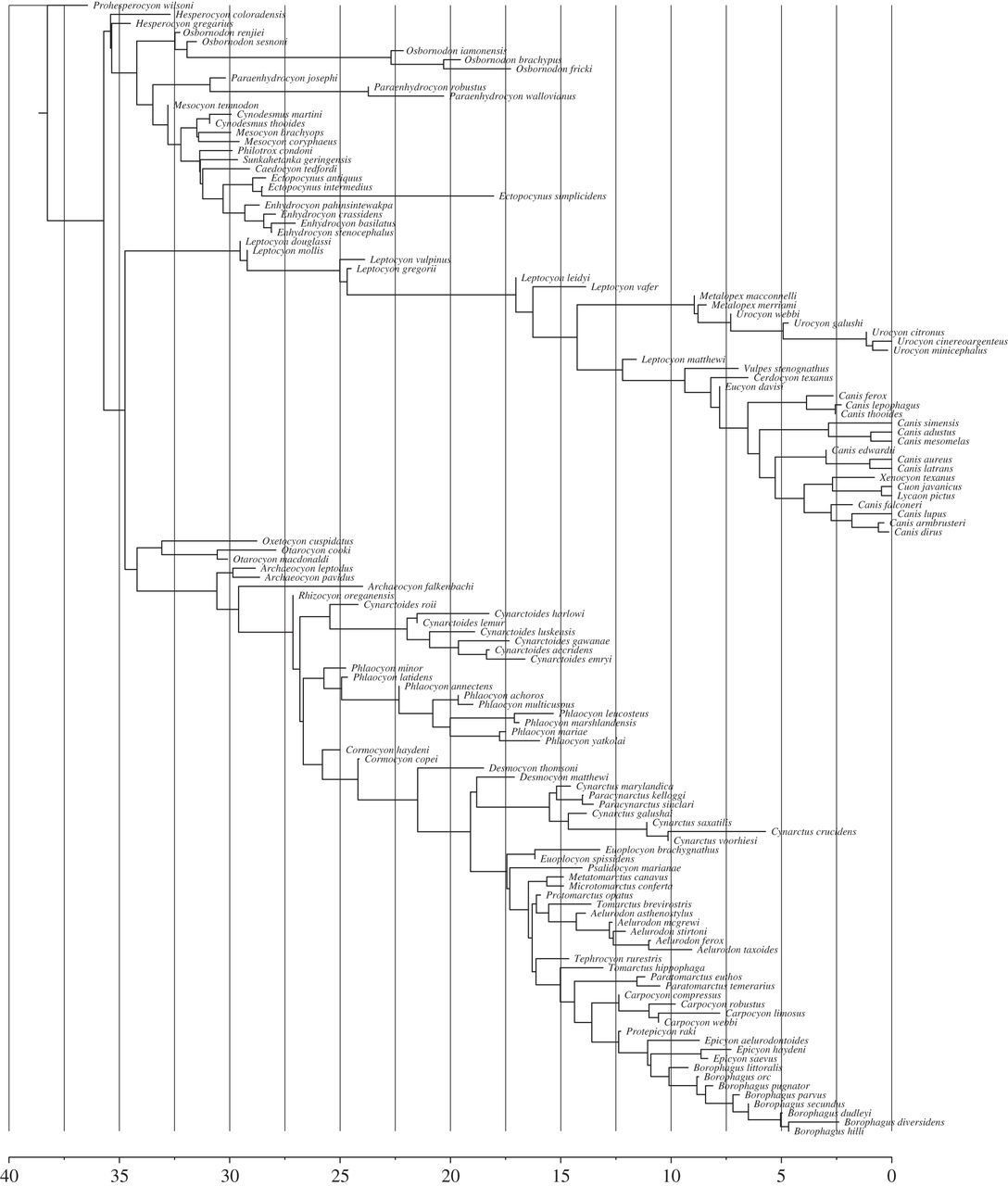
A sample from the posterior distribution of an analysis of the canid dataset, showing three main clades, one clade with extant representatives and two extinct clades (Hesperocyoninae and Borophaginae). The x-axis is in units of million years ago.

Abstract

Recent advances have allowed for both morphological fossil evidence and molecular sequences to be integrated into a single combined inference of divergence dates under the rule of Bayesian probability. In particular, the fossilized birth–death tree prior and the Lewis-Mk model of discrete morphological evolution allow for the estimation of both divergence times and phylogenetic relationships between fossil and extant taxa. We exploit this statistical framework to investigate the internal consistency of these models by producing phylogenetic estimates of the age of each fossil in turn, within two rich and well-characterized datasets of fossil and extant species (penguins and canids). We find that the estimation accuracy of fossil ages is generally high with credible intervals seldom excluding the true age and median relative error in the two datasets of 5.7% and 13.2%, respectively. The median relative standard error (RSD) was 9.2% and 7.2%, respectively, suggesting good precision, although with some outliers. In fact, in the two datasets we analyse, the phylogenetic estimate of fossil age is on average less than 2 Myr from the mid-point age of the geological strata from which it was excavated. The high level of internal consistency found in our analyses suggests that the Bayesian statistical model employed is an adequate fit for both the geological and morphological data, and provides evidence from real data that the framework used can accurately model the evolution of discrete morphological traits coded from fossil and extant taxa. We anticipate that this approach will have diverse applications beyond divergence time dating, including dating fossils that are temporally unconstrained, testing of the ‘morphological clock', and for uncovering potential model misspecification and/or data errors when controversial phylogenetic hypotheses are obtained based on combined divergence dating analyses.

This article is part of the themed issue ‘Dating species divergences using rocks and clocks’.

FREE PDF GRATIS: Phil Trans R Soc B

Um modelo de relógio misto livre

A mixed relaxed clock model

Nicolas Lartillot, Matthew J. Phillips, Fredrik Ronquist

Published 20 June 2016. DOI: 10.1098/rstb.2015.0132

Inferred divergence times under the mixed clock, using the tip-dating approach (posterior median, coloured bars: 95% credible intervals; red bars: Placentalia, as well as orders and super-orders indicated to the right).
Abstract

Over recent years, several alternative relaxed clock models have been proposed in the context of Bayesian dating. These models fall in two distinct categories: uncorrelated and autocorrelated across branches. The choice between these two classes of relaxed clocks is still an open question. More fundamentally, the true process of rate variation may have both long-term trends and short-term fluctuations, suggesting that more sophisticated clock models unfolding over multiple time scales should ultimately be developed. Here, a mixed relaxed clock model is introduced, which can be mechanistically interpreted as a rate variation process undergoing short-term fluctuations on the top of Brownian long-term trends. Statistically, this mixed clock represents an alternative solution to the problem of choosing between autocorrelated and uncorrelated relaxed clocks, by proposing instead to combine their respective merits. Fitting this model on a dataset of 105 placental mammals, using both node-dating and tip-dating approaches, suggests that the two pure clocks, Brownian and white noise, are rejected in favour of a mixed model with approximately equal contributions for its uncorrelated and autocorrelated components. The tip-dating analysis is particularly sensitive to the choice of the relaxed clock model. In this context, the classical pure Brownian relaxed clock appears to be overly rigid, leading to biases in divergence time estimation. By contrast, the use of a mixed clock leads to more recent and more reasonable estimates for the crown ages of placental orders and superorders. Altogether, the mixed clock introduced here represents a first step towards empirically more adequate models of the patterns of rate variation across phylogenetic trees.

This article is part of the themed issue ‘Dating species divergences using rocks and clocks’.

FREE PDF GRATIS: Phil Trans R Soc B

Uma exploração molecular paleobiológica da terrestrialização dos artrópodes

A molecular palaeobiological exploration of arthropod terrestrialization

Jesus Lozano-Fernandez, Robert Carton, Alastair R. Tanner, Mark N. Puttick, Mark Blaxter, Jakob Vinther, Jørgen Olesen, Gonzalo Giribet, Gregory D. Edgecombe, Davide Pisani

Published 20 June 2016. DOI: 10.1098/rstb.2015.0133


Bayesian phylogeny of Panarthropoda. This tree was obtained under the CAT − GTR + G model. All nodes but one had a posterior probability of 1. bpcomp maxdiff = 0; minimum effective size = 55; maximum rel_diff = 0.2. Most silhouettes from organisms are from Phylopic (phylopic.org/).

Abstract

Understanding animal terrestrialization, the process through which animals colonized the land, is crucial to clarify extant biodiversity and biological adaptation. Arthropoda (insects, spiders, centipedes and their allies) represent the largest majority of terrestrial biodiversity. Here we implemented a molecular palaeobiological approach, merging molecular and fossil evidence, to elucidate the deepest history of the terrestrial arthropods. We focused on the three independent, Palaeozoic arthropod terrestrialization events (those of Myriapoda, Hexapoda and Arachnida) and showed that a marine route to the colonization of land is the most likely scenario. Molecular clock analyses confirmed an origin for the three terrestrial lineages bracketed between the Cambrian and the Silurian. While molecular divergence times for Arachnida are consistent with the fossil record, Myriapoda are inferred to have colonized land earlier, substantially predating trace or body fossil evidence. An estimated origin of myriapods by the Early Cambrian precedes the appearance of embryophytes and perhaps even terrestrial fungi, raising the possibility that terrestrialization had independent origins in crown-group myriapod lineages, consistent with morphological arguments for convergence in tracheal systems.

This article is part of the themed issue ‘Dating species divergences using rocks and clocks’.

FREE PDF GRATIS: Phil Trans R Soc B

Blocos tectônicos e relógios moleculares

Tectonic blocks and molecular clocks

Kenneth De Baets, Alexandre Antonelli, Philip C. J. Donoghue

Published 20 June 2016. DOI: 10.1098/rstb.2016.0098


Possible relationship between divergences of terrestrial groups with different dispersal abilities and the age constraints from the break-up of continents and formation of oceans. Continent reconstructions are simplified after Stanley & Luczaj [37].

Abstract

Evolutionary timescales have mainly used fossils for calibrating molecular clocks, though fossils only really provide minimum clade age constraints. In their place, phylogenetic trees can be calibrated by precisely dated geological events that have shaped biogeography. However, tectonic episodes are protracted, their role in vicariance is rarely justified, the biogeography of living clades and their antecedents may differ, and the impact of such events is contingent on ecology. Biogeographic calibrations are no panacea for the shortcomings of fossil calibrations, but their associated uncertainties can be accommodated. We provide examples of how biogeographic calibrations based on geological data can be established for the fragmentation of the Pangaean supercontinent: (i) for the uplift of the Isthmus of Panama, (ii) the separation of New Zealand from Gondwana, and (iii) for the opening of the Atlantic Ocean. Biogeographic and fossil calibrations are complementary, not competing, approaches to constraining molecular clock analyses, providing alternative constraints on the age of clades that are vital to avoiding circularity in investigating the role of biogeographic mechanisms in shaping modern biodiversity.

This article is part of the themed issue ‘Dating species divergences using rocks and clocks’.

FREE PDF GRATIS: Phil Trans R Soc B

A evolução dos métodos para estabelecer períodos evolutivos

The evolution of methods for establishing evolutionary timescales

Philip C. J. Donoghue, Ziheng Yang

Published 20 June 2016. DOI: 10.1098/rstb.2016.0020

Tip-calibration relies upon a molecular sequence alignment from living species, a morphological character set for living and fossil species, and a prior topology (a); total-evidence dating co-estimates topology and timescale. Branch lengths are estimated in a Bayesian MCMC approach based on both data types for living lineages and based on morphological data alone for the extinct lineages; these are calibrated to time based on the age of the fossil species (b). The divergence time estimates and inferred rates of molecular and morphological evolution are based on a consensus of the MCMC analysis (c)

Abstract

The fossil record is well known to be incomplete. Read literally, it provides a distorted view of the history of species divergence and extinction, because different species have different propensities to fossilize, the amount of rock fluctuates over geological timescales, as does the nature of the environments that it preserves. Even so, patterns in the fossil evidence allow us to assess the incompleteness of the fossil record. While the molecular clock can be used to extend the time estimates from fossil species to lineages not represented in the fossil record, fossils are the only source of information concerning absolute (geological) times in molecular dating analysis. We review different ways of incorporating fossil evidence in modern clock dating analyses, including node-calibrations where lineage divergence times are constrained using probability densities and tip-calibrations where fossil species at the tips of the tree are assigned dates from dated rock strata. While node-calibrations are often constructed by a crude assessment of the fossil evidence and thus involves arbitrariness, tip-calibrations may be too sensitive to the prior on divergence times or the branching process and influenced unduly affected by well-known problems of morphological character evolution, such as environmental influence on morphological phenotypes, correlation among traits, and convergent evolution in disparate species. We discuss the utility of time information from fossils in phylogeny estimation and the search for ancestors in the fossil record.

This article is part of the themed issue ‘Dating species divergences using rocks and clocks’.

FREE PDF GRATIS: Phil Trans R Soc B

A Royal Society vai discutir novas tendências em biologia evolucionária: 7-9 de novembro de 2016

terça-feira, junho 28, 2016

New trends in evolutionary biology: biological, philosophical and social science perspectives


Scientific meeting

Starts: November 07 2016 09:00 Add to calendar

Ends: November 09 2016 17:00 Add to calendar


Location 

The Royal Society, London, 6-9 Carlton House Terrace, London, SW1Y 5AG


Overview

Scientific discussion meeting organised in partnership with the British Academy by Professor Denis Noble CBE FMedSci FRS, Professor Nancy Cartwright, Professor Sir Patrick Bateson FRS, Professor John Dupré and Professor Kevin Laland.

Developments in evolutionary biology and adjacent fields have produced calls for revision of the standard theory of evolution, although the issues involved remain hotly contested. This meeting will present these developments and arguments in a form that will encourage cross-disciplinary discussion and, in particular, involve the humanities and social sciences in order to provide further analytical perspectives and explore the social and philosophical implications.

The schedule of talks, and biographies of the organisers and speakers are available below. Alternatively you can download the draft programme (PDF). Speaker abstracts will be available closer to the meeting date. Recorded audio of the talks will be available on this page after the event has taken place.

Attending this event

This event is intended for researchers in relevant fields and is free to attend, but advance registration is essential. An optional lunch can be purchased at the time of registration and is priced at £20 per day. 


+++++

NOTA DESTE BLOGGER:

Em 1998 este blogger anunciou que uma iminente e eminente mudança paradigmática em biologia evolucionária estava por acontecer em razão das muitas anomalias e dificuldades que a teoria da evolução de Darwin - na sua versão Síntese Evolutiva Moderna enfrentava no contexto de justificação teórica desde os anos 1980s. Foi Stephen Jay Gould quem afirmou ser a teoria neodarwinista apenas ortodoxia nos livros didáticos, mas não entre os que praticavam ciência normal e a discutiam intramuros e em artigos científicos. 

Apesar de ter me apoiado em um dos gigantes daquele paradigma evolutivo, este blogger foi vilipendiado por muitos cientistas da Nomenklatura científica e pela Galera dos meninos e meninas de Darwin. Sempre ressaltei aqui - eu fico muito lisonjeado quando sou vindicado por evolucionistas honestos. Imagine agora ser vindicado por um encontro de cientistas na The Royal Society de Londres, Inglaterra. O coração bate rucututuco, e eu, não sei por que, rio daqueles que riram e zombaram do então simples professor de ensino médio, hoje mestre em História da Ciência pela PUC-São Paulo.

O bom é que a ciência e a mentira não podem andar de mãos dadas, pois a ciência é a busca pela verdade científica dos fatos encontrados na realidade. A mudança paradigmática já se deu em agosto de 2015 com o lançamento da nova teoria geral da evolução - a SÍNTESE EVOLUTIVA AMPLIADA/ESTENDIDA, que relegou a seleção natural a segundo plano e incorporou teses neolamarckistas. Mas o que significa tudo isso para o fato, Fato, FATO da evolução não foi contado aos alunos do ensino médio e superior, e nem é debatido em salas de aulas. Quanta bobagem de patrulhamento de conhecimentos que estão ao alcance de uma tecla de computador plugado na internet!

Parabéns, The Royal Society, pela iniciativa de demonstrar que Darwin não é corroborado no contexto de justificação teórica e algo precisa ser feito a respeito.

Darwin kaput desde 1859!!!

Debate da Síntese Evolutiva Ampliada/Estendida: onde a ciência se encontra com a filosofia, mas os alunos não ficam sabendo!

segunda-feira, junho 27, 2016

The Extended (Evolutionary) Synthesis Debate: Where Science Meets Philosophy

Massimo Pigliucci and Leonard Finkelman

- Author Affiliations

Massimo Pigliucci (massimo@platofootnote.org) and Leonard Finkelman are affiliated with the Philosophy Program in the City University of New York's Graduate Center.

Source/Fonte: PNAS Bernardi 2007

Abstract

Recent debates between proponents of the modern evolutionary synthesis (the standard model in evolutionary biology) and those of a possible extended synthesis are a good example of the fascinating tangle among empirical, theoretical, and conceptual or philosophical matters that is the practice of evolutionary biology. In this essay, we briefly discuss two case studies from this debate, highlighting the relevance of philosophical thinking to evolutionary biologists in the hope of spurring further constructive cross-pollination between the two fields.

Key words: modern synthesis extended synthesis philosophy of science epigenetic inheritance levels of selection

FREE PDF GRATIS: BioScience